The Bold Pivot: an Interview with John Foster on Calvin Quate and the Birth of AFM, Forty Years After AFM – A Personal Reflection from the Stanford Lab
- 20 May 2026
- Volume 30
- NANOscientific Magazine, 2026
In 1986, the atomic force microscope (AFM) was introduced to the scientific community, transforming our ability to explore the nanoscale. At the center of that breakthrough was Calvin F. Quate, whose bold leadership at Stanford University reshaped the trajectory of scanning probe microscopy.
By the early 1980s, Quate’s laboratory was already internationally recognized for pioneering acoustic microscopy. His emphasis on mechanical scanning had pushed resolution to remarkable limits, and the group was operating at the forefront of precision imaging. Yet even at the height of that success, Quate was looking ahead. After visiting IBM Zurich and observing early work on the scanning tunneling microscope, he made a decisive move: redirecting his entire lab toward this emerging technology. That pivot would soon lead not only to Stanford’s STM efforts, but to the invention of AFM — an instrument capable of imaging insulating surfaces and ultimately enabling nanoscale research across physics, materials science, biology, and semiconductor technology.
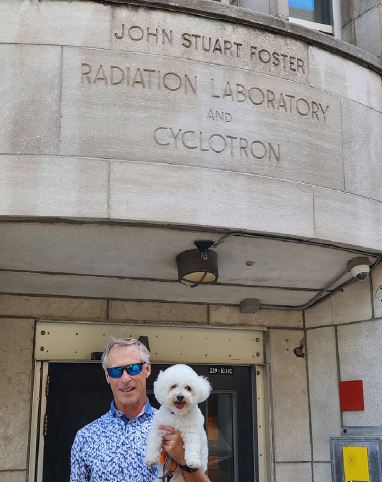
John Foster, now Chief Operating Officer of Shiftwave Inc., was a graduate student in Quate’s lab during this transformative period. In this interview, he reflects on the revolutionary shift inside the lab, Quate’s distinctive mentoring style, and the fearless mindset that helped bring AFM into existence and shape generations of innovators.
NS: When you joined Cal Quate’s lab at Stanford, what was the atmosphere like?
Foster: It was exhilarating. By the early 1980s, the lab was leading the world in acoustic microscopy. We were pushing resolution to extraordinary levels — experiments at cryogenic temperatures, even down to millidegrees Kelvin. These were technically demanding, sometimes exotic experiments, and the expectation was clear: when we presented our work, we had to know more than anyone else in the room.
It felt like being at the top of the world scientifically. But what I didn’t realize at the time was that we were already standing in the middle of a much larger revolution.
NS: Do you remember the moment when Cal decided to pivot the entire lab toward scanning tunneling microscopy?
Foster: Very clearly. Cal had visited IBM Zurich and seen the early tunneling experiments. Almost overnight, he announced that the lab would shift to STM — and soon after, AFM. That meant no more acoustic microscopy students.
We were stunned. We were doing so well. Why abandon a field where we were leaders? But Cal showed no hesitation. No backup plan. No mitigation strategy. Just bold conviction.
That decision taught me one of the most important lessons of my career: sometimes innovation requires abandoning success.
NS: How did Cal approach risk?
Foster: Fearlessly. Imagine being the most recognized figure in a field and walking away from it to pursue something uncertain. That’s what he did.
He didn’t overanalyze it. He didn’t hedge. He simply believed in the direction and moved. From a business standpoint, that seems reckless. But from a scientific standpoint, it was visionary.
We all jumped in with him.
NS: How would you describe his mentoring style?
Foster: Unconventional. We had no formal group meetings during my four years there. Cal led with big ideas — “We’re going this way now” — but he was often deliberately vague about the details.
We would leave his office unsure whether we had approval or not. Escaping without being stopped often counted as tacit approval.
If he truly disliked something, he would simply call out your name with a tone of anguish: “John…” That was it. No explanation. You had to figure out what to fix.
In hindsight, it forced us to think independently. He wasn’t going to solve problems for you. You had to invent the solution yourself.
NS: STM was already revealing atomic resolution. Why push further toward AFM?
Foster: From the beginning, Cal had a vision beyond STM. STM could only image conductive surfaces. Cal wanted to scan insulating materials. At the time, I didn’t see the need. We were already seeing atoms! But he was looking ahead.
The early AFM experiments were incredibly hard — piggybacking an STM onto a cantilever just to read its motion. It was complicated and fragile. But again, Cal encouraged risk. He believed if something was worth doing, we would find a way to make it work.
And eventually, we did.
NS: The earliest AFM experiments were quite complex. Can you describe how the first implementations actually worked?
Foster: The earliest versions were incredibly complex — much more than what people might imagine today. One of the first approaches essentially involved piggybacking a scanning tunneling microscope onto a cantilever. So you had the cantilever interacting with the surface, and then an STM trying to read out the motion of that cantilever.
But STM itself was already very challenging — vibration isolation, electrical noise, ultra-high vacuum. Now we were stacking another layer of complexity on top of that. It made the whole system extremely difficult to operate.
Those early measurements were hard-won. People would spend long periods just trying to get a single line trace. It wasn’t a push-button instrument by any means.
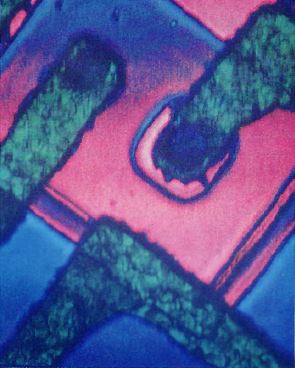
circuit segment showing two micron aluminum
conductors with sub-micron density features.
NS: What were the biggest technical challenges in making AFM a workable instrument?
Foster: There were several. First, detecting the motion of the cantilever with sufficient sensitivity was a major hurdle. The initial approaches were not very practical, which is why the optical readout became such an important breakthrough later.
Then there were the usual challenges we were already dealing with in STM — vibration isolation, environmental control, and noise reduction. All of that carried over.
But beyond the hardware, there was also the conceptual challenge. We were trying to measure forces at an extremely small scale and translate that into meaningful images. That required a lot of experimentation and intuition.
NS: Looking back, what do you think was the most critical breakthrough that enabled AFM to become widely adopted?
Foster: I would say the combination of two things: the conceptual leap and the practical implementation.
The conceptual leap was recognizing that you could image surfaces using forces rather than tunneling current — and that this would allow you to work with insulating materials.
But the practical side was just as important. Without reliable ways to detect cantilever motion and stabilize the system, it wouldn’t have gone very far.
Once those pieces came together, AFM became much more than a laboratory curiosity. It became a versatile tool that could be applied across many fields.
NS: What was the lab culture like during that transition?
Foster: It was intense. We were expected to attempt experiments others considered nearly impossible. Vibration isolation, ultra-high vacuum systems, extreme precision — that was the norm.
But there was also a sense of joy. Cal loved exploration. He loved windsurfing, hiking, adventure. Even when he wasn’t good at something — like windsurfing — he kept doing it because he loved it.
That mindset translated into the lab: don’t be afraid of failure. Keep trying.
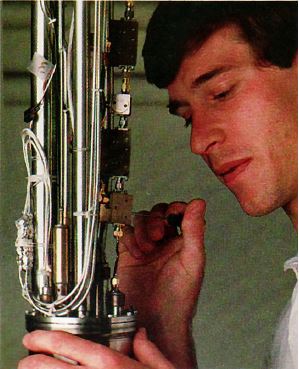
helium acoustic microscope
cryostat beforecooling.
NS: How did Cal’s influence extend beyond AFM?
Foster: Years later, when I was working on MEMS technologies, Cal introduced me to the idea of cell sorting for medical applications. He didn’t tell me how to solve it. He just pointed me in the direction and said, “Go talk to this person.”
He had a way of planting seeds without dictating the outcome. That conversation changed my career. Eventually, the technology that grew from those ideas is now used in major medical research facilities worldwide.
He taught us how to think boldly — not just how to build microscopes.
NS: What made Calvin Quate truly exceptional?
Foster: He wasn’t driven by ego. He didn’t campaign for awards. He just kept doing great things.
What made him happiest was seeing his students succeed. I never saw him more joyful than when he talked about what others had accomplished. That’s rare.
His legacy isn’t just AFM. It’s the mindset he instilled: take risks, pursue big ideas, and let others grow beyond you.
NS: As we mark 40 years of AFM, what lessons remain most relevant today?
Foster: The biggest lesson is courage.
Courage to pivot.
Courage to leave a successful path.
Courage to attempt something that may fail.
AFM didn’t emerge from incremental improvement. It came from bold redirection. That lesson applies just as much today as it did in 1986.
NS: Dr. Foster, thank you for sharing your reflections and for giving us a firsthand look at the vision and courage behind the birth of AFM.
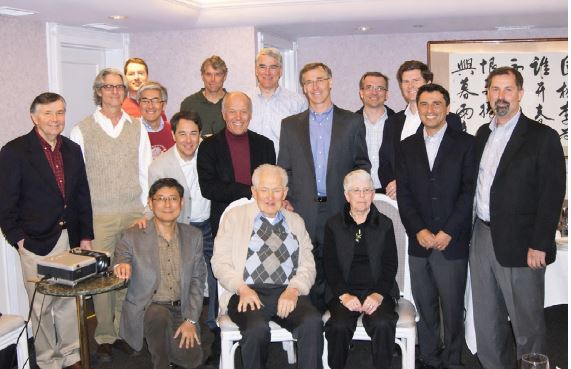
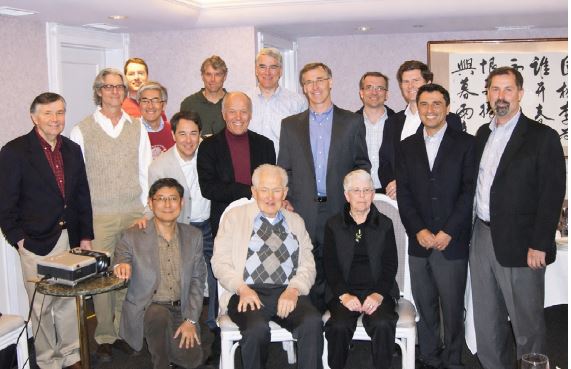
(Foster standing in blue shirt).